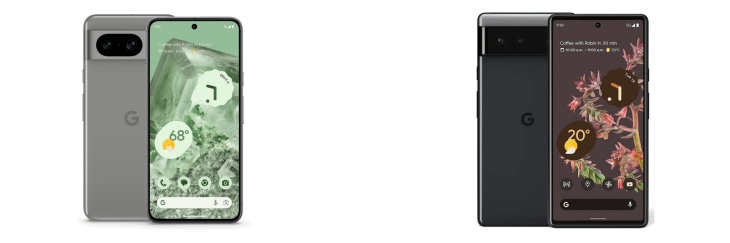
Google Pixel 8 & Google Pixel 6 share many similarities, but there are also important differences, such as quality, performance, features, design, and connectivity. If you want the best one between them, I Would recommend the Google Pixel 8 rather than the Google Pixel 6.
Why Do I Recommend The Google Pixel 8?
- The Google Pixel 8 has a next-generation Tensor G3 chip that improves AI performance, enhances voice recognition, accelerates image processing, and ensures smoother multitasking compared to the Pixel 6’s original Tensor chip.
- Google Pixel 8 features a 6.2″ Actua display with adaptive 120Hz refresh rate that delivers smoother scrolling, more responsive touch input, and better visual fluidity than the Pixel 6’s fixed 90Hz screen.
- It includes a front-facing 10.5 MP camera that enables sharper selfies and supports 4K video recording, compared to the Pixel 6’s 8 MP front camera with only 1080p support.
- The Google Pixel 8 supports up to 2000 nits of peak brightness that ensures excellent visibility even in direct sunlight, whereas the Pixel 6 display peaks at a lower brightness level.
- Google Pixel 8 comes with 7 years of software, security, and feature updates that extend device longevity and maintain up-to-date performance longer than the Pixel 6’s 5-year support window.
- It features faster 27W wired charging that reduces downtime and charges the device more quickly than the Pixel 6’s 21W capability.
- The Google Pixel 8 includes advanced AI photo tools like Magic Editor and Best Take that enhance editing flexibility and improve photo outcomes beyond the standard features in the Pixel 6.
- Google Pixel 8 has a more compact and lighter design that improves one-handed usability and comfort during extended use compared to the bulkier and heavier Pixel 6.
Maybe the Google Pixel 6 price can make you comfortable because it’s a little bit cheaper than the Google Pixel 8. But you have to compromise all the above-mentioned features. Now the Decision is Yours. I hope it was helpful to choose the right one.
.
Side By Side Comparison
| Feature | Google Pixel 8 | Google Pixel 6 |
| Chipset | Google Tensor | Google Tensor G3 |
| Display Size | 6.4 inches | 6.2 inches |
| Display Refresh Rate | 90Hz | 60–120Hz |
| Display Brightness | ~800 nits (typical), ~1200 nits (peak) | Up to 1400 nits (HDR), 2000 nits |
| RAM Type | LPDDR5 | LPDDR5X |
| Charging Speed (Wireless) | 21W | 18W |
| Dimensions | 158.6 × 74.8 × 8.9 mm | 150.5 × 70.8 × 8.9 mm |
| Weight | 207g | 187g |
| Video Front Camera | 1080p@30fps | 4K@30/60fps |
| OS Support Window | Android 12–16 | Android 14–21 |
| Face Unlock | Not supported | Supported |
| Camera Features | Magic Eraser, Real Tone, Motion Mode | Magic Editor, Best Take, Audio Magic Eraser |
| Software Updates | 3 OS + 5 years security | 7 years full |
| Build Material | Gorilla Glass Victus front and back | Gorilla Glass Victus front, matte glass back |
| Color Options | Sorta Seafoam, Kinda Coral, Stormy Black | Hazel, Obsidian, Rose |
| Price | Check Pixel 8 Price | Check Pixel 6 Price |
What Common Both Can Do?
- Stock Android Experience: Both the Pixel 6 and Pixel 8 run Google’s clean, bloat-free Android interface with fast updates and Material You design customization.
- 50 MP Main Camera: Each model features a high-resolution 50 MP wide-angle main camera using a similar sensor, ensuring excellent detail, dynamic range, and color science.
- 12 MP Ultrawide Lens: Both devices include a 12 MP ultrawide camera for capturing expansive scenes, group shots, or creative perspectives.
- Video Recording: Both phones support 4K video at 30/60fps and slow-motion capabilities at up to 240fps in 1080p, offering flexible content creation.
- Google Computational Photography: Features like HDR+, Night Sight, Magic Eraser, Portrait Light, and Real Tone are shared across both models to enhance images through AI processing.
- Durability & IP Rating: The Pixel 6 and Pixel 8 both feature IP68 water and dust resistance, providing peace of mind for everyday spills and rain exposure.
- Titan M2 Security Chip: Each phone includes the Titan M2 chip for on-device encryption, secure boot, and biometric data protection.
- Under-display Fingerprint Sensor: Both models use an optical fingerprint sensor embedded under the display for biometric security.
- Wireless Charging Support: Qi wireless charging is supported on both phones, offering convenient charging options without cables.
- Google Ecosystem Integration: The Pixel 6 and 8 both support core Google services such as Google Assistant, Live Translate, Recorder app with real-time transcription, and seamless integration with Google Photos.
Common Features
| Feature | Google Pixel 8 | Google Pixel 6 |
| Manufacturer | ||
| Operating System | Android | Android |
| Main Camera Resolution | 50 MP wide sensor | 50 MP wide sensor |
| Ultrawide Camera | 12 MP | 12 MP |
| Main Camera Video | 4K@30/60fps, 1080p@30/60/120/240fps | 4K@30/60fps, 1080p@30/60/120/240fps |
| Image Processing | Google computational photography | Google computational photography |
| Build Quality | IP68 water and dust resistance | IP68 water and dust resistance |
| Rear Camera Features | Magic Eraser, Real Tone, Motion Mode | Magic Eraser, Real Tone, Motion Mode |
| Security Chip | Titan M2 security chip | Titan M2 security chip |
| Biometric Authentication | Under-display fingerprint sensor | Under-display fingerprint sensor |
| Network Support | 5G connectivity | 5G connectivity |
| USB Type-C Port | USB-C | USB-C |
| Wireless Charging | Qi wireless charging supported | Qi wireless charging supported |
| Google Services | Google Assistant, Google Photos integration, Recorder with smart transcription | Google Assistant, Google Photos integration, Recorder with smart transcription |
| Material (Front) | Gorilla Glass Victus | Gorilla Glass Victus |
| Core Android Experience | No bloatware, Material You design, Direct OS updates | No bloatware, Material You design, Direct OS updates |
| Price | Check Pixel 8 Price | Check Pixel 6 Price |