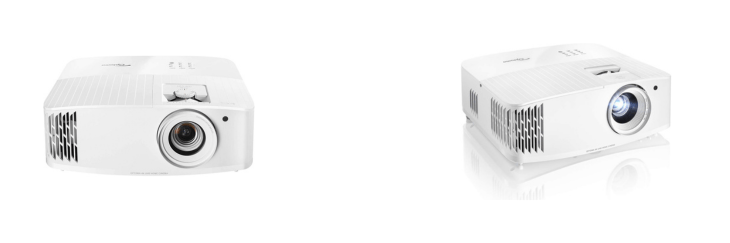
Optoma UHD50X & Optoma UHD30 share many similarities, but there are also important differences, such as quality, performance, features, design, and connectivity. If you want the best one between them, I Would recommend the Optoma UHD50X rather than the Optoma UHD30.
Why Do I Recommend The Optoma UHD50X?
- The Optoma UHD50X features a vertical lens shift mechanism for easier and more flexible image alignment during installation, whereas the Optoma UHD30 lacks any lens shift adjustment.
- Optoma UHD50X comes with a 1.3× optical zoom to fine-tune image size without moving the projector, while the Optoma UHD30 uses a shorter 1.1× zoom.
- It supports PureMotion frame interpolation for smoother motion in movies and sports scenes, whereas the Optoma UHD30 does not include any frame interpolation technology.
- The Optoma UHD50X has a shorter .21–1.59:1 throw ratio to project larger images from a closer distance, while the Optoma UHD30 has a longer throw ratio of 1.50–1.66:1.
- Optoma UHD50X includes a longer-lasting 15,000-hour lamp in Dynamic mode for reduced maintenance and lower replacement cost, while the Optoma UHD30’s lamp is rated for up to 10,000 hours in Eco mode.
- It features slightly lower input lag at 16 ms (1080p/240 Hz) for more responsive gaming performance, whereas the Optoma UHD30 has an input lag around 16.7 ms.
- The Optoma UHD50X supports PureMotion technology and Dynamic Black control together to enhance contrast and reduce motion blur, while the Optoma UHD30 relies solely on Dynamic Black.
- Optoma UHD50X includes a more advanced optical system with higher zoom flexibility and lens shift to simplify ceiling or shelf mounting, while the Optoma UHD30 requires more precise manual positioning.
Maybe the Optoma UHD30 can make you comfortable because it’s a little bit cheaper than the Optoma UHD50X. But you have to compromise all the above-mentioned features. Now the Decision is Yours. I hope it was helpful to choose the right one.
Side By Side Comparison
| Feature | Optoma UHD50X | Optoma UHD30 |
| Optical Zoom | 1.3× | 1.1× |
| Vertical Lens Shift | Yes (+10%) | No |
| Lamp Life (Dynamic/Eco) | Up to 15,000 h | Up to 10,000 h |
| Installation Flexibility | Higher | Lower |
| Ideal Room Size | Smaller room friendly | Requires more distance |
| Optical Adjustments | Manual zoom + vertical shift | Manual zoom only |
| Power Consumption | 300W | 295W |
| Mount Flexibility | Higher | Basic |
| Weight | 3.8 kg | 3.9 kg |
| Frame Interpolation | PureMotion | None |
| Lens Shift | Vertical +10% | None |
| Price | Check UHD50X Price | Check UHD30 Price |
What Common Both Can Do?
- Native Resolution: Both projectors display a true 4K UHD resolution (3840×2160), providing crisp details and high clarity for movies, games, and streaming content. This ensures a cinematic viewing experience with precise pixel rendering.
- HDR Compatibility: Each model supports HDR10 and HLG formats, improving contrast and brightness for realistic images. This shared capability helps both projectors deliver richer blacks and brighter highlights in HDR content.
- Refresh Rate: Both can achieve up to 240Hz refresh rates at 1080p, making them excellent for fast-paced gaming. The high refresh rate minimizes motion blur and enhances smoothness in gameplay and sports broadcasts.
- Input Lag (Gaming Mode): Both include low-latency gaming modes that reduce input lag significantly. This shared feature ensures better responsiveness for console and PC gamers.
- HDMI Ports: Each projector provides two HDMI inputs (one HDMI 2.0 and one HDMI 1.4a) for connecting multiple devices such as consoles, Blu-ray players, or streaming boxes. This makes switching between sources seamless.
- Color Wheel: Both utilize an 8-segment RGBWRGBW color wheel, producing vibrant and accurate color reproduction. This technology enhances realism and supports rich color depth in various lighting conditions.
- Dynamic Black Technology: Each unit employs Dynamic Black to enhance contrast dynamically by adjusting lamp output. This improves perceived black levels and shadow detail during dark scenes.
- 3D Support: Both projectors support Full HD 3D playback for immersive visuals when paired with compatible glasses. This makes them suitable for home theater enthusiasts who enjoy 3D films.
- Keystone Correction: Each model offers ±40° vertical keystone correction, allowing quick image alignment on various screen heights. This helps achieve a perfect rectangular projection even when the unit isn’t centered.
- Lamp Type: Both use the same 240W UHP lamp, balancing brightness and longevity. This ensures consistent color performance and easier maintenance across both models.
- Color Accuracy: Each projector covers 100% of the Rec.709 color gamut, delivering cinema-grade color accuracy. This guarantees lifelike visuals true to directors’ intended tones.
- Lamp Replacement Type: Both models have user-replaceable lamps, simplifying maintenance and extending usability. Owners can easily swap bulbs without needing professional service.
- Projection System: Each projector uses DLP (Digital Light Processing) technology, known for sharp images and long-term reliability. DLP ensures minimal degradation and fast color switching for stable visuals.
- Aspect Ratio: Both share a 16:9 native aspect ratio, ideal for widescreen content. This ensures consistent compatibility with most modern video formats and games.
- Audio Output: Each includes a 3.5mm audio output jack, enabling easy connection to external speakers or sound systems. This provides flexible audio upgrade options for users seeking better sound quality.
- USB Port: Both feature a USB port for powering streaming devices or servicing firmware updates. This increases convenience for setups involving Chromecast, Fire TV, or Roku sticks.
- VGA Input: Each projector includes a VGA input for legacy devices or PCs. This maintains compatibility with older laptops or presentation equipment.
- Ceiling Mountable: Both models support ceiling mounting, allowing flexible installation for home theaters. This shared design feature ensures a clean and permanent setup option.
- Remote Control Included: Each comes with a dedicated remote for on-screen control and menu navigation. This makes adjustments and mode switching simple and intuitive from a distance.
- Eco Mode: Both feature energy-saving Eco modes that reduce lamp brightness to extend lifespan and lower power use. This mode also helps minimize fan noise during quieter viewing sessions.
Common Features
| Feature | Optoma UHD50X | Optoma UHD30 |
| Native Resolution | 4K UHD | 4K UHD |
| HDR Compatibility | HDR10, HLG | HDR10, HLG |
| Refresh Rate | Up to 240Hz | Up to 240Hz |
| Input Lag (Gaming Mode) | Yes | Yes |
| HDMI Ports | 2 | 2 |
| Color Wheel | 8-segment RGBWRGBW | 8-segment RGBWRGBW |
| Dynamic Black Technology | Yes | Yes |
| 3D Support | Yes | Yes |
| Keystone Correction | Vertical ±40° | Vertical ±40° |
| Lamp Type | 240W UHP | 240W UHP |
| Color Accuracy | 100% Rec.709 | 100% Rec.709 |
| Lamp Replacement Type | User-Replaceable | User-Replaceable |
| Projection System | DLP | DLP |
| Aspect Ratio | 16:9 | 16:9 |
| Audio Output | 3.5mm Jack | 3.5mm Jack |
| USB Port | Yes | Yes |
| VGA Input | Yes | Yes |
| Ceiling Mountable | Yes | Yes |
| Remote Control Included | Yes | Yes |
| Eco Mode | Yes | Yes |
| Price | Check UHD50X Price | Check UHD30 Price |
FAQ
Does the Optoma UHD50X and UHD30 both support true 4K resolution? Are the Optoma UHD50X and UHD30 good for gaming? Do both models support HDR content? Can the UHD50X and UHD30 display 3D content? What projection technology do these models use? Do both projectors have built-in speakers? Are the Optoma UHD50X and UHD30 compatible with ceiling mounting? Do these projectors support HDMI 2.0 connections? Can I use streaming sticks like Chromecast or Fire TV with these projectors? Do both projectors feature keystone correction? How bright are the Optoma UHD50X and UHD30 projectors? What is the lamp life expectancy of these models? Do both projectors include remote controls? Are these projectors compatible with consoles like PlayStation and Xbox? Can the Optoma UHD50X and UHD30 be used for presentations as well as entertainment? |