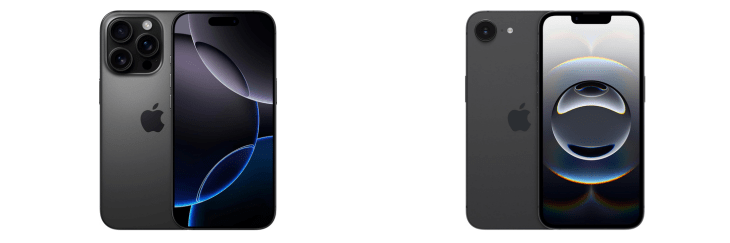
iPhone 16 Pro Max & iPhone 16e share many similarities, but there are also important differences, such as quality, performance, features, design, and connectivity. If you want the best one between them, I Would recommend the iPhone 16 Pro Max rather than the iPhone 16e.
Why Do I Recommend The iPhone 16 Pro Max?
- The iPhone 16 Pro Max features a 6.9-inch LTPO Super Retina XDR OLED display with ProMotion 120Hz for smoother scrolling, gaming, and animations, whereas the iPhone 16e has a smaller 6.1-inch Super Retina XDR OLED display limited to 60Hz.
- iPhone 16 Pro Max has the A18 Pro chip with a 6-core GPU for faster graphics performance and smoother AI-driven tasks, whereas the iPhone 16e uses the standard A18 chip with a 4-core GPU.
- It comes with a triple-lens camera system including wide, ultra-wide, and telephoto with 5x optical zoom for versatile photography and clearer long-distance shots, while the iPhone 16e uses a single 48MP wide camera with only digital zoom.
- The iPhone 16 Pro Max supports MagSafe and Qi2 wireless charging for faster and more reliable magnetic alignment, while the iPhone 16e supports only standard Qi wireless charging without MagSafe or Qi2.
- iPhone 16 Pro Max features USB-C with high-speed data transfer and DisplayPort output to connect external displays, while the iPhone 16e uses USB-C limited to slower USB 2.0 speeds.
- It includes Wi-Fi 7 and an advanced Qualcomm modem with UWB for faster wireless speeds and precise spatial connectivity, whereas the iPhone 16e has Wi-Fi 6 and an Apple-designed C1 modem without UWB support.
- The iPhone 16 Pro Max has a titanium frame with a textured matte glass back for premium durability and scratch resistance, while the iPhone 16e uses an aluminum frame with reinforced glossy glass.
- iPhone 16 Pro Max delivers up to 33 hours of video playback for longer-lasting endurance during travel and heavy use, whereas the iPhone 16e provides up to 26 hours of video playback.
Maybe the iPhone 16e price can make you comfortable because it’s a little bit cheaper than the iPhone 16 Pro Max. But you have to compromise all the above-mentioned features. Now the Decision is Yours. I hope it was helpful to choose the right one.
Side By Side Comparison
| Feature | iPhone 16 Pro Max | iPhone 16e |
| Display Type | LTPO Super Retina XDR OLED | Super Retina XDR OLED |
| Refresh Rate | ProMotion 120Hz adaptive | Standard 60Hz |
| Display Features | Always-On, Dynamic Island | No Always-On, Notch design |
| Brightness | Peak up to 2000 nits | Peak up to ~1200 nits |
| Processor | A18 Pro with 6-core GPU | A18 with 4-core GPU |
| Camera System | Triple-lens | Single 48MP Fusion camera |
| Video Capabilities | 4K up to 120fps with Dolby Vision | 4K up to 60fps with Dolby Vision |
| Camera Controls | Dedicated Camera Control button | No Camera Control button |
| Storage Options | 256GB, 512GB, 1TB | 128GB, 256GB, 512GB |
| Wireless Charging | MagSafe + Qi2 supported | Standard Qi only |
| USB-C | High-speed (supports DisplayPort) | USB 2.0 speeds only |
| Connectivity | Wi-Fi 7, UWB chip | Wi-Fi 6, no UWB |
| Modem | Qualcomm 5G modem | Apple-designed C1 modem |
| Battery Life | Up to ~33 hours video playback | Up to ~26 hours video playback |
| Special Buttons | Camera Control + Action Button | Action Button only |
| AI Features | Full Apple Intelligence suite with Pro GPU optimizations | Apple Intelligence supported but limited by hardware |
| Price | Check iPhone 16 Pro Max Price | Check iPhone 16e Price |
What Common Both Can Do?
- Operating System: Both iPhone 16 Pro Max and iPhone 16e run iOS 18 with Apple Intelligence, ensuring that users experience the latest features, security updates, and AI-powered tools like enhanced Siri, generative writing assistance, and contextual suggestions.
- Processor Family: Even though the Pro Max has the A18 Pro variant and the 16e has the standard A18, both belong to the same generation, providing powerful performance, energy efficiency, and AI-driven enhancements.
- Face ID: Both models feature Apple’s advanced 3D facial recognition technology for secure unlocking, app authentication, and payments, making them equally safe in terms of biometric security.
- Main Camera Sensor: Each device uses a 48MP wide camera with pixel-binning technology, allowing for sharper photos, better low-light performance, and higher-resolution images despite differences in secondary lenses.
- Video Recording: Both support 4K Dolby Vision HDR recording, giving users cinematic-quality videos with excellent dynamic range, contrast, and vibrant colors.
- Front Camera: A 12MP TrueDepth camera system with Face ID is shared across both devices, providing clear selfies, accurate facial tracking, and smooth video calls.
- Ceramic Shield: Both devices come with Ceramic Shield glass, which increases durability and drop resistance, giving users stronger protection against everyday mishaps.
- IP Rating: IP68 certification on both models ensures water resistance up to 6 meters for 30 minutes and protection against dust, making them durable for daily use.
- USB-C Port: Both phones include USB-C charging ports, which standardize accessories and simplify connectivity, even though their data transfer speeds differ.
- 5G Support: Each phone supports 5G networks, enabling faster internet speeds, smoother streaming, and better connectivity in supported areas.
- Emergency SOS: Both support Emergency SOS via satellite, which lets users contact emergency services in areas without cellular coverage, adding a vital safety layer.
- Crash Detection: Equipped with accelerometers, gyroscopes, and AI detection, both devices can detect severe car crashes and automatically call emergency services.
- Wireless Charging: Each model works with Qi-certified wireless chargers, making it convenient to charge without cables, even if MagSafe differs between them.
- Software Updates: Both phones are eligible for multiple years of iOS updates, ensuring long-term usability, security patches, and access to new Apple features.
- Apple Services: Seamless integration with Apple Pay, iCloud, Apple Music, and Fitness+ means both devices provide the full Apple ecosystem experience for productivity, health, and entertainment.
Common Features
| Feature | iPhone 16 Pro Max | iPhone 16e |
| Operating System | Runs iOS 18 with Apple Intelligence | Runs iOS 18 with Apple Intelligence |
| Processor Family | Both use A18-series chipset | Both use A18-series chipset |
| Face ID | Secure 3D facial recognition | Secure 3D facial recognition |
| Main Camera Sensor | 48MP wide camera with pixel-binning | 48MP wide camera with pixel-binning |
| Video Recording | Supports 4K Dolby Vision HDR | Supports 4K Dolby Vision HDR |
| Front Camera | 12MP TrueDepth front camera with Face ID | 12MP TrueDepth front camera with Face ID |
| Ceramic Shield | Both use Ceramic Shield glass protection | Both use Ceramic Shield glass protection |
| IP Rating | IP68 dust and water resistance | IP68 dust and water resistance |
| USB-C Port | Equipped with USB-C connector | Equipped with USB-C connector |
| 5G Support | Supports 5G connectivity | Supports 5G connectivity |
| Emergency SOS | Supports satellite SOS | Supports satellite SOS |
| Crash Detection | Built-in crash detection sensors | Built-in crash detection sensors |
| Wireless Charging | Supports Qi wireless charging | Supports Qi wireless charging |
| Software Updates | Eligible for long-term iOS updates | Eligible for long-term iOS updates |
| Apple Services | Fully compatible with Apple ecosystem | Fully compatible with Apple ecosystem |
| Price | Check iPhone 16 Pro Max Price | Check iPhone 16e Price |
FAQ
Do both the iPhone 16 Pro Max and iPhone 16e run the same software? Is the display quality different between the two models? How do the cameras compare between the iPhone 16 Pro Max and iPhone 16e? Do both phones support Face ID? Is battery life significantly different? Do both devices support wireless charging? Is storage capacity the same on both models? Do they both use USB-C ports? Are both models water and dust resistant? Is there a weight difference between the two? Do both phones support 5G connectivity? Do both have access to Apple Intelligence features? Who should buy the iPhone 16 Pro Max and who should consider the iPhone 16e? |