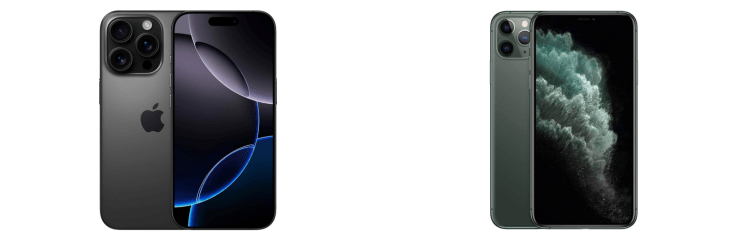
iPhone 16 Pro Max & iPhone 11 Pro Max share many similarities, but there are also important differences, such as quality, performance, features, design, and connectivity. If you want the best one between them, I Would recommend the iPhone 16 Pro Max rather than the iPhone 11 Pro Max.
Why Do I Recommend The iPhone 16 Pro Max?
- The iPhone 16 Pro Max features the A18 Pro chip built on 3nm with Apple Intelligence support for faster performance, energy efficiency, and advanced AI functions, while the iPhone 11 Pro Max uses the older A13 Bionic chip on 7nm with no AI capabilities.
- iPhone 16 Pro Max comes with a 48MP main sensor and a 12MP telephoto lens with 5x optical zoom for sharper images and greater versatility in photography, while the iPhone 11 Pro Max includes a 12MP main sensor and a telephoto limited to 2x zoom.
- It has a 6.9-inch Super Retina XDR OLED display with 120Hz ProMotion for smoother scrolling and more responsive gaming, whereas the iPhone 11 Pro Max has a 6.5-inch Super Retina XDR OLED display limited to 60Hz.
- The iPhone 16 Pro Max supports 4K video recording at up to 120fps with advanced HDR for smoother high-frame-rate video capture, whereas the iPhone 11 Pro Max supports 4K video at up to 60fps with standard HDR.
- iPhone 16 Pro Max has a dedicated Camera Control button for quicker access to photo and video adjustments, while the iPhone 11 Pro Max lacks any dedicated physical camera control.
- It includes a larger 4685 mAh battery to provide up to 33 hours of video playback for longer daily use, whereas the iPhone 11 Pro Max has a 3969 mAh battery.
- The iPhone 16 Pro Max supports 5G connectivity and Wi-Fi 7 for faster data speeds and improved network stability, while the iPhone 11 Pro Max uses only 4G LTE and Wi-Fi 6.
- iPhone 16 Pro Max comes with a titanium frame for increased durability and a lighter feel relative to its size, whereas the iPhone 11 Pro Max uses a stainless steel frame.
Maybe the iPhone 11 Pro Max price can make you comfortable because it’s a little bit cheaper than the iPhone 16 Pro Max. But you have to compromise all the above-mentioned features. Now the Decision is Yours. I hope it was helpful to choose the right one.
Side By Side Comparison
| Feature | iPhone 16 Pro Max | iPhone 11 Pro Max |
| Display Size | 6.9-inch | 6.5-inch |
| Display Refresh Rate | 120Hz ProMotion adaptive | 60Hz standard |
| Display Features | Always-On, Dynamic Island | Standard notch, no Always-On |
| Brightness | Up to 2000 nits peak, 1 nit minimum | Up to 1200 nits peak, no ultra-low minimum |
| Processor | A18 Pro chip (3nm) with Apple Intelligence | A13 Bionic chip |
| AI Features | On-device Apple Intelligence suite | No AI integration |
| Main Camera | 48MP advanced wide sensor | 12MP wide sensor |
| Telephoto Camera | 12MP with up to 5x optical zoom | 12MP with up to 2x optical zoom |
| Video Recording | 4K up to 120fps with advanced HDR | 4K up to 60fps with standard HDR |
| Camera Controls | Dedicated Camera Control button | No dedicated camera control |
| Battery Life | Up to ~33 hours video playback | Up to ~20 hours video playback |
| Charging Port | USB-C | Lightning |
| Connectivity | 5G, Wi-Fi 7, Bluetooth 5.3 | 4G LTE, Wi-Fi 6, Bluetooth 5.0 |
| Frame Material | Titanium with thinner bezels | Stainless steel |
| Operating System | iOS 18 at launch | iOS 13 at launch |
| Software Longevity | Supported well into 2030s | Nearing end of major iOS support |
| Storage Options | Up to 1TB | Up to 512GB |
| Biometrics | Face ID with improved sensors | Face ID first generation |
| Audio | Spatial Audio with advanced Dolby Atmos tuning | Spatial Audio limited implementation |
| Price | Check iPhone 16 Pro Max Price | Check iPhone 11 Pro Max Price |
What Common Both Can Do?
- Display Type: Both iPhones use Super Retina XDR OLED panels, ensuring high contrast ratios, deep blacks, and vibrant color reproduction.
- HDR Support: Both models support HDR10 and Dolby Vision, enabling more dynamic range when viewing supported content like movies and videos.
- True Tone: Each device uses True Tone sensors that adjust the white balance based on ambient lighting, making the display more comfortable on the eyes.
- Wide Color Gamut: With P3 wide color gamut, both phones display a broader range of colors, ensuring more accurate visuals for photography and video playback.
- Rear Camera Count: Each device features a triple-camera setup with wide, ultra-wide, and telephoto lenses, giving users flexible shooting options.
- Night Mode: Both devices include Night Mode for low-light photography, automatically improving brightness and reducing noise in dark settings.
- Portrait Mode: Each phone has Portrait Mode with depth control, allowing blurred backgrounds and adjustable focus for professional-style photos.
- Optical Image Stabilization: Both models have OIS on their main and telephoto cameras, reducing motion blur and stabilizing shots in photos and videos.
- Front Camera: Both feature a TrueDepth camera system that powers selfies and Face ID facial recognition.
- Video Features: 4K video recording with extended dynamic range is available on both, ensuring crisp detail and better highlights/shadows in footage.
- Stereo Recording: Each iPhone records video with stereo sound, enhancing playback quality for more immersive audio.
- Biometric Security: Both rely on Face ID, Apple’s advanced facial recognition system, as the primary biometric security method.
- Wireless Charging: Both support Qi wireless charging, enabling cable-free charging with compatible pads.
- Water Resistance: Each phone is IP68 rated, which means resistance to water immersion and protection from dust ingress.
- Materials: Both feature glass on the front and back for a premium look and feel, coupled with durable metal frames.
- Audio Playback: Spatial Audio with Dolby Atmos is supported on both, enhancing immersion when listening to music or watching videos.
- NFC: Both include NFC functionality for Apple Pay, making mobile payments quick and secure.
- Dual SIM Option: Both support dual SIM with one physical SIM and one eSIM, giving flexibility for multiple carriers or travel use.
Common Features
| Feature | iPhone 16 Pro Max | iPhone 11 Pro Max |
| Display Type | Super Retina XDR OLED | Super Retina XDR OLED |
| HDR Support | Supports HDR10 and Dolby Vision | Supports HDR10 and Dolby Vision |
| True Tone | True Tone technology for natural color balance | True Tone technology for natural color balance |
| Wide Color Gamut | P3 wide color gamut | P3 wide color gamut |
| Rear Camera Count | Triple-camera system | Triple-camera system |
| Night Mode | Night Mode on rear cameras | Night Mode on rear cameras |
| Portrait Mode | Portrait Mode with depth control | Portrait Mode with depth control |
| Optical Image Stabil. | Optical image stabilization on main and telephoto | Optical image stabilization on main and telephoto |
| Front Camera | TrueDepth front camera with Face ID | TrueDepth front camera with Face ID |
| Video Features | 4K video recording with extended dynamic range | 4K video recording with extended dynamic range |
| Stereo Recording | Stereo audio recording in video | Stereo audio recording in video |
| Biometric Security | Face ID facial recognition | Face ID facial recognition |
| Wireless Charging | Supports Qi wireless charging | Supports Qi wireless charging |
| Water Resistance | IP68 water and dust resistance | IP68 water and dust resistance |
| Materials | Premium glass front and back construction | Premium glass front and back construction |
| Audio Playback | Spatial Audio and Dolby Atmos | Spatial Audio and Dolby Atmos |
| NFC | NFC with Apple Pay support | NFC with Apple Pay support |
| Dual SIM Option | Dual SIM with eSIM support | Dual SIM with eSIM support |
| Price | Check iPhone 16 Pro Max Price | Check iPhone 11 Pro Max Price |
FAQ
What is the difference in display size between the iPhone 16 Pro Max and the iPhone 11 Pro Max? Do both models use the same type of display technology? How do the processors compare between the two phones? Does the iPhone 16 Pro Max support artificial intelligence features? Are the rear cameras significantly different between the two models? What are the video recording capabilities of each phone? How does battery life compare between the two phones? Do both models support wireless charging? Are there differences in water resistance ratings? What materials are used in the design of each phone? Do both phones support Face ID? What storage options are available for each device? Are both phones compatible with 5G networks? What operating system did each phone launch with? |