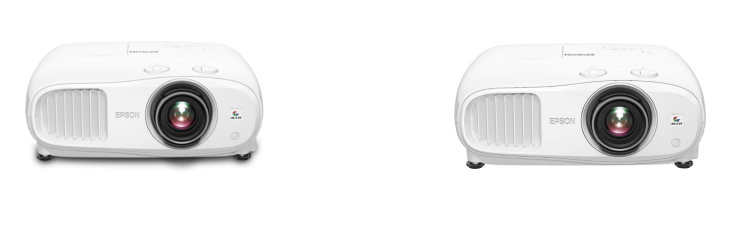
Epson 3800 & Epson 3200 share many similarities, but there are also important differences, such as quality, performance, features, design, and connectivity. If you want the best one between them, I Would recommend the Epson 3800 rather than the Epson 3200.
Why Do I Recommend The Epson 3800?
- The Epson 3800 features a higher 100,000:1 contrast ratio to deliver deeper blacks and improved shadow detail in dark scenes, whereas the Epson 3200 features a lower 40,000:1 contrast ratio.
- Epson 3800 comes with a 6-segment RGBRGB color wheel for more accurate and saturated color reproduction, while the Epson 3200 uses a 4-segment RGBW color wheel that slightly reduces color depth.
- It supports full 18 Gbps HDMI bandwidth to handle 4K60 4:4:4 HDR content without compression, whereas the Epson 3200 supports only 10.2 Gbps HDMI bandwidth with limited 4K30 4:2:0 signals.
- The Epson 3800 includes a 10-bit color processing engine to produce smoother gradients and lifelike tones, while the Epson 3200 includes an 8-bit color system.
- Epson 3800 features 16.7 milliseconds input lag for faster gaming responsiveness, whereas the Epson 3200 features a higher 27 milliseconds input lag.
- It supports HDR10 and HLG formats to deliver better dynamic range across both streaming and broadcast content, while the Epson 3200 supports only HDR10.
- The Epson 3800 includes ISF Day and Night calibration modes to enable precise image tuning for professional setups, whereas the Epson 3200 lacks dedicated ISF calibration options.
- Epson 3800 has a quieter 24–32 decibels fan for reduced background noise during movies, while the Epson 3200 runs louder at 27–37 decibels under similar conditions.
Maybe the Epson 3200 can make you comfortable because it’s a little bit cheaper than the Epson 3800. But you have to compromise all the above-mentioned features. Now the Decision is Yours. I hope it was helpful to choose the right one.
Side By Side Comparison
| Feature | Epson 3800 | Epson 3200 |
| Brightness | 3000 lumens | 2900 lumens |
| Contrast Ratio | 100,000:1 | 40,000:1 |
| Color Wheel | 6-segment RGBRGB | 4-segment RGBW |
| HDMI Bandwidth | 18 Gbps | 10.2 Gbps |
| HDR Support | HDR10, HLG | HDR10 |
| Input Lag | ~16.7 ms | ~27 ms |
| Refresh Rate | 240 Hz (1080p) | 120 Hz (1080p) |
| Color Depth | 10-bit | 8-bit |
| Image Processing | 12-bit Digital Processing | 10-bit Processing |
| Frame Interpolation | Yes | No |
| ISF Calibration Modes | Yes | No |
| Color Management | Advanced 3D CMS | Basic CMS |
| Color Accuracy | High | Moderate |
| Rec.709 Coverage | 100% | 95% |
| Rec.2020 Compatibility | Partial | None |
| HDR Tone Mapping | Advanced | Standard |
| Fan Noise | 24–32 dB | 27–37 dB |
| Gaming Support | 4K Low-Latency Mode | Standard Gaming Mode |
| Dynamic Iris | Automatic | Manual |
| HDMI Signal Support | 4K60 4:4:4 | 4K30 4:2:0 |
| Lens Type | Precision All-Glass | Standard Glass |
| Color Uniformity | Enhanced | Basic |
| Motion Handling | Smooth with FI | Average |
| Noise Reduction | Advanced | Basic |
| Power Consumption | 350 W | 340 W |
| Price | Check Epson 3800 Price | Check Epson 3200 Price |
What Common Both Can Do?
- Resolution: Both projectors deliver 4K PRO-UHD resolution using pixel-shifting technology. This allows them to project detailed and sharp images without requiring a native 4K panel, maintaining a strong balance between clarity and performance.
- Projection Technology: Each model uses Epson’s 3LCD system, ensuring vibrant, color-rich images with no rainbow effect common in single-chip DLP projectors. The 3LCD architecture provides better color brightness and balanced white levels.
- Lens Shift: Both projectors feature generous vertical and horizontal lens shift, making installation flexible across various mounting positions. This allows precise image alignment without distorting the picture.
- Zoom Ratio: A 1.62x manual zoom lens is shared between both, providing versatile setup distances. This flexibility helps in different room sizes without needing to move the projector.
- Throw Ratio: Each model uses the same 1.32–2.15 throw ratio range, offering identical projection distances for comparable screen sizes. This makes them easy to interchange in the same mounting location.
- Keystone Correction: Both have ±30° vertical keystone correction, allowing quick image alignment on uneven projection surfaces. It helps users achieve a rectangular picture without physical repositioning.
- 3D Support: Each supports Full HD 3D playback using active shutter glasses, delivering immersive movie experiences for compatible Blu-ray and game content.
- Lamp Life (Eco Mode): The two projectors share the same lamp longevity of 5000 hours in Eco mode, ensuring consistent brightness and reduced maintenance over time.
- Lamp Life (Normal Mode): In Normal mode, both lamps last approximately 3500 hours, giving users identical performance and replacement schedules.
- Replacement Lamp Model: Both use the same ELPLP85 replacement lamp, simplifying maintenance and compatibility for users upgrading from one model to the other.
- HDMI Ports: Each includes two HDMI ports compatible with HDCP 2.2, supporting 4K video sources like Blu-ray players, gaming consoles, and streaming devices.
- Wireless Projection Support: Both models can add wireless connectivity through an optional Epson wireless adapter, enabling screen mirroring and casting without cables.
- Lens Cover: Each uses a manual lens cover for basic lens protection when not in use, preventing dust accumulation and scratches.
- Color Reproduction: Both support full Rec.709 color gamut coverage, ensuring cinema-standard color accuracy and consistency across SDR content.
- Image Enhancement: Each projector enhances detail using Epson’s pixel-shifting 4K PRO-UHD processing, which refines texture and clarity beyond native 1080p resolution.
- Supported Screen Size: Both can project up to 300 inches diagonally, allowing for large-format home theater setups without losing image sharpness.
- Power Consumption (Eco Mode): They share similar power efficiency levels in Eco mode at around 280 watts, reducing energy consumption and heat output during prolonged sessions.
- 3D Glasses Compatibility: Each unit supports active RF 3D glasses, ensuring compatibility with standard Epson 3D accessories for consistent depth and synchronization.
- Aspect Ratio: Both use a native 16:9 aspect ratio ideal for HD and 4K content playback, maintaining the correct proportions for modern films and TV content.
- Operating Temperature: Both are rated for the same 41°F to 95°F operating range, ensuring stable performance in varied environmental conditions for home or studio use.
Common Features
| Feature | Epson 3800 | Epson 3200 |
| Resolution | 4K PRO-UHD | 4K PRO-UHD |
| Projection Technology | 3LCD | 3LCD |
| Lens Shift | ±60% Vertical, ±24% Horizontal | ±60% Vertical, ±24% Horizontal |
| Zoom Ratio | 1.62x Manual | 1.62x Manual |
| Throw Ratio | 1.32–2.15 | 1.32–2.15 |
| Keystone Correction | ±30° Vertical | ±30° Vertical |
| 3D Support | Yes | Yes |
| Lamp Life (Eco Mode) | 5000 Hours | 5000 Hours |
| Lamp Life (Normal Mode) | 3500 Hours | 3500 Hours |
| Replacement Lamp Model | ELPLP85 | ELPLP85 |
| HDMI Ports | 2 | 2 |
| Wireless Projection Support | Optional Adapter | Optional Adapter |
| Lens Cover | Manual | Manual |
| Color Reproduction | 100% Rec.709 | 100% Rec.709 |
| Image Enhancement | Pixel Shifting 4K | Pixel Shifting 4K |
| Supported Screen Size | Up to 300 inches | Up to 300 inches |
| Power Consumption (Eco Mode) | 280 W | 280 W |
| 3D Glasses Compatibility | Active RF Type | Active RF Type |
| Aspect Ratio | 16:9 Native | 16:9 Native |
| Operating Temperature | 41°F–95°F | 41°F–95°F |
| Price | Check Epson 3800 Price | Check Epson 3200 Price |