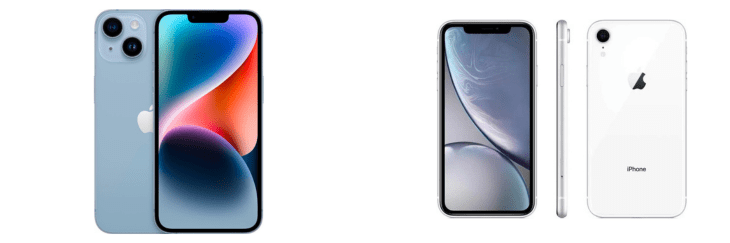
iPhone 14 & iPhone XR share many similarities, but there are also important differences, such as quality, performance, features, design, and connectivity. If you want the best one between them, I Would recommend the iPhone 14 rather than the iPhone XR.
Why Do I Recommend The iPhone 14?
- The iPhone 14 has the A15 Bionic chip with a 5-core GPU for faster performance, smoother gaming, and longer support lifespan, while the iPhone XR uses the older A12 Bionic chip with a 4-core GPU.
- iPhone 14 features a Super Retina XDR OLED display with 2532 × 1170 resolution for sharper text, richer colors, and higher contrast, whereas the iPhone XR uses a Liquid Retina LCD with 1792 × 828 resolution.
- It includes a dual 12 MP camera system with Wide and Ultra-Wide lenses for versatile photography, while the iPhone XR has only a single 12 MP Wide camera.
- The iPhone 14 supports Night Mode and Photonic Engine for brighter and clearer low-light images, whereas the iPhone XR does not support Night Mode and struggles in dark environments.
- iPhone 14 has a 12 MP front camera with autofocus for sharper selfies and 4K video recording, while the iPhone XR uses a 7 MP front camera without autofocus and is limited to 1080p video.
- It supports 5G connectivity for faster downloads, smoother streaming, and lower latency in supported regions, whereas the iPhone XR is limited to 4G LTE.
- The iPhone 14 comes with MagSafe wireless charging and accessory compatibility for faster charging and easier attachment, while the iPhone XR only supports standard Qi wireless charging.
- iPhone 14 features IP68 water resistance to withstand 6 meters of water for 30 minutes, whereas the iPhone XR has IP67 water resistance limited to 1 meter for 30 minutes.
Maybe the iPhone XR price can make you comfortable because it’s a little bit cheaper than the iPhone 14. But you have to compromise all the above-mentioned features. Now the Decision is Yours. I hope it was helpful to choose the right one.
Side By Side Comparison
| Feature | iPhone 14 | iPhone XR |
| Processor | A15 Bionic | A12 Bionic |
| Neural Engine | 16-core | 8-core |
| RAM | 6 GB | 3 GB |
| Display Type | Super Retina XDR OLED | Liquid Retina IPS LCD |
| Display Resolution | 2532 × 1170 | 1792 × 828 |
| Pixel Density | ~460 ppi | ~326 ppi |
| Contrast Ratio | 2,000,000:1 | 1,400:1 |
| Brightness (Typical) | 800 nits | 625 nits |
| Brightness (HDR Peak) | 1200 nits | Not supported |
| HDR Support | HDR10, Dolby Vision | None |
| Main Camera | Dual 12 MP | Single 12 MP |
| Night Mode | Supported | Not supported |
| Cinematic Mode | Supported | Not supported |
| Photonic Engine | Supported | Not available |
| Front Camera | 12 MP with autofocus | 7 MP fixed focus |
| Front Camera Video | 4K Dolby Vision HDR | 1080p |
| Battery Life (Video Playback) | Up to 20 hours | Up to 16 hours |
| Battery Capacity | ~3279 mAh | ~2942 mAh |
| Charging Speed | 20W fast charging | 15W fast charging |
| MagSafe | Supported | Not supported |
| Connectivity | 5G, Wi-Fi 6, Bluetooth 5.3 | 4G LTE, Wi-Fi 5, Bluetooth 5.0 |
| SIM | eSIM + nano-SIM | nano-SIM + eSIM |
| Build Protection | Ceramic Shield front | Glass front |
| Water Resistance | IP68 | IP67 |
| Weight | 172 g | 194 g |
| OS at Launch | iOS 16 | iOS 12 |
| Face ID | Faster, newer sensor | First-generation |
| Price | Check iPhone 14 Price | Check iPhone XR Price |
What Common Both Can Do?
- Display Size: Both the iPhone 14 and iPhone XR feature a 6.1-inch display, giving users nearly the same overall screen real estate for browsing, video watching, and gaming.
- Aspect Ratio: Each phone uses a 19.5:9 aspect ratio, which keeps the tall, narrow design that feels comfortable in the hand and supports cinematic video playback.
- Refresh Rate: Neither device supports a high refresh rate; both are limited to 60 Hz, resulting in a consistent but standard scrolling and animation smoothness.
- True Tone: Both models include Apple’s True Tone technology, which adjusts white balance dynamically based on ambient light for more natural viewing.
- Wide Color Gamut: Each device supports the P3 color space, ensuring rich, vibrant colors in photos, videos, and supported apps.
- Haptic Touch: Both iPhones use Haptic Touch, giving users tactile feedback when pressing icons, menus, or shortcuts on the screen.
- Face ID: Both devices rely on Face ID for secure biometric authentication, allowing quick unlocking and secure app logins.
- Notch Design: Each phone uses the classic notch at the top of the display, housing the Face ID sensors and front camera.
- Primary Camera Resolution: Both iPhones use a 12 MP wide main camera sensor, capable of capturing high-resolution photos.
- Optical Image Stabilization: Both phones feature OIS on the primary lens, reducing blur in handheld photography and keeping video steadier.
- Portrait Mode: Both models can shoot Portrait Mode photos with adjustable depth, creating blurred backgrounds and DSLR-like effects.
- 4K Video Recording: Each phone records video up to 4K at 60fps, ensuring high-quality video capture with smooth frame rates.
- Slow Motion: Both phones support 1080p slow-motion recording at 120fps and 240fps, allowing for creative video effects.
- Stereo Recording: Each device records video with stereo sound, providing fuller and more immersive audio during playback.
- Wireless Charging: Both iPhone 14 and iPhone XR support Qi wireless charging, letting users charge without plugging in a cable.
- Lightning Port: Each device uses Apple’s Lightning port for wired charging and data transfer, keeping compatibility with older accessories.
- Materials: Both iPhones use an aluminum frame paired with a glass back, balancing durability with a premium look.
- Dust Resistance: Both devices are dust-resistant, designed to prevent particles from entering and damaging internal components.
- Operating System: Both run iOS and benefit from Apple’s long-term software update cycle, ensuring continued support and new features.
Common Features
| Feature | iPhone 14 | iPhone XR |
| Display Size | 6.1-inch screen | 6.1-inch screen |
| Aspect Ratio | 19.5:9 aspect ratio | 19.5:9 aspect ratio |
| Refresh Rate | Standard 60 Hz | Standard 60 Hz |
| True Tone | Supported | Supported |
| Wide Color Gamut | P3 color | P3 color |
| Haptic Touch | Supported | Supported |
| Face ID | Present | Present |
| Notch Design | Yes | Yes |
| Primary Camera Resolution | 12 MP main sensor | 12 MP main sensor |
| Optical Image Stabilization | Supported on main camera | Supported on main camera |
| Portrait Mode | Available with depth control | Available with depth control |
| 4K Video Recording | Up to 4K 60fps | Up to 4K 60fps |
| Slow Motion | 1080p at 120/240fps | 1080p at 120/240fps |
| Stereo Recording | Available | Available |
| Wireless Charging | Qi wireless charging | Qi wireless charging |
| Lightning Port | Present | Present |
| Materials | Aluminum frame + glass back | Aluminum frame + glass back |
| Dust Resistance | Both sealed against dust | Both sealed against dust |
| Operating System | iOS with long-term updates | iOS with long-term updates |
| Price | Check iPhone 14 Price | Check iPhone XR Price |
FAQ
Is the iPhone 14 faster than the iPhone XR? Do both the iPhone 14 and iPhone XR have the same screen size? Does the iPhone 14 have a better camera than the iPhone XR? Can both the iPhone 14 and iPhone XR record in 4K? Is the selfie camera better on the iPhone 14? Which phone has better battery life, iPhone 14 or iPhone XR? Do both phones support wireless charging? Does the iPhone 14 support 5G while the iPhone XR does not? Is the iPhone 14 lighter than the iPhone XR? Which phone has better water resistance, iPhone 14 or iPhone XR? Do both phones use Face ID for security? Do both the iPhone 14 and iPhone XR have the same charging port? Can both phones run the latest iOS software? Do both phones have dual SIM support? Is the display quality better on the iPhone 14 than the iPhone XR? |