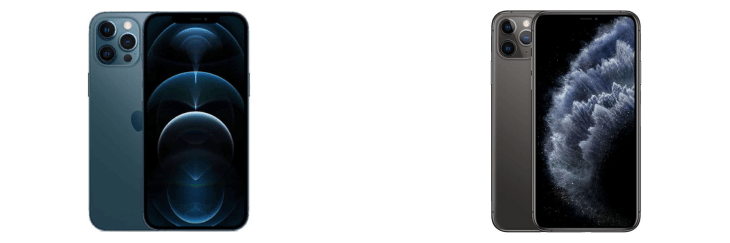
iPhone 12 Pro Max & iPhone 11 Pro Max share many similarities, but there are also important differences, such as quality, performance, features, design, and connectivity. If you want the best one between them, I Would recommend the iPhone 12 Pro Max rather than the iPhone 11 Pro Max.
Why Do I Recommend The iPhone 12 Pro Max?
- The iPhone 12 Pro Max comes with the A14 Bionic chip for faster performance and more power-efficient multitasking, while the iPhone 11 Pro Max uses the A13 Bionic chip.
- iPhone 12 Pro Max has a 6.7-inch Super Retina XDR OLED display for a more immersive viewing experience with sharper detail, whereas the iPhone 11 Pro Max has a 6.5-inch Super Retina XDR OLED display.
- It features a Ceramic Shield front for improved drop resistance and greater durability, while the iPhone 11 Pro Max uses standard glass.
- The iPhone 12 Pro Max supports 5G connectivity for significantly faster download speeds and lower latency, whereas the iPhone 11 Pro Max is limited to 4G LTE.
- iPhone 12 Pro Max has a 65mm telephoto lens with 2.5x optical zoom for closer and clearer zoomed photos, while the iPhone 11 Pro Max uses a 52mm telephoto lens with 2x optical zoom.
- It includes a LiDAR scanner for enhanced low-light autofocus and advanced AR applications, whereas the iPhone 11 Pro Max does not include a LiDAR scanner.
- The iPhone 12 Pro Max supports Dolby Vision HDR video recording at up to 60fps for higher-quality, cinematic footage, while the iPhone 11 Pro Max records standard HDR video.
- iPhone 12 Pro Max has MagSafe charging support up to 15W for faster and more convenient magnetic wireless charging, while the iPhone 11 Pro Max only supports Qi wireless charging up to 7.5W.
Maybe the iPhone 11 Pro Max price can make you comfortable because it’s a little bit cheaper than the iPhone 12 Pro Max. But you have to compromise all the above-mentioned features. Now the Decision is Yours. I hope it was helpful to choose the right one.
Side By Side Comparison
| Feature | iPhone 12 Pro Max | iPhone 11 Pro Max |
| Display Size | 6.7-inch Super Retina XDR OLED | 6.5-inch Super Retina XDR OLED |
| Display Protection | Ceramic Shield | Standard glass |
| Processor | A14 Bionic chip | A13 Bionic chip |
| Connectivity | 5G support | 4G LTE only |
| Telephoto Zoom | 2.5x optical zoom | 2x optical zoom |
| LiDAR Scanner | Yes | No |
| Main Camera Stabilization | Sensor-shift OIS | Dual OIS |
| Video Recording | Dolby Vision HDR up to 60fps | HDR video up to 60fps |
| Night Mode | All cameras (rear + front) | Wide and front only |
| Design | Flat edges | Rounded edges |
| Dimensions | 160.8 × 78.1 × 7.4 mm | 158.0 × 77.8 × 8.1 mm |
| Weight | 228g | 226g |
| Charging | MagSafe up to 15W | Qi up to 7.5W |
| Base Storage | 128GB | 64GB |
| Water Resistance | IP68, 6m for 30 min | IP68, 4m for 30 min |
| Front Camera Features | Night Mode and Deep Fusion | No Night Mode, limited Deep Fusion |
| Color Options | Pacific Blue, Gold, Silver, Graphite | Midnight Green, Gold, Silver, Space Gray |
| Frame Style | Flat stainless steel | Curved stainless steel |
| Price | Check iPhone 12 Pro Max Price | Check iPhone 11 Pro Max Price |
What Common Both Can Do?
- Display Type: Both iPhone 12 Pro Max and iPhone 11 Pro Max use Super Retina XDR OLED technology, delivering deep blacks, high contrast, and vivid colors for immersive visuals.
- Resolution: Each device has a very high pixel density, ensuring text and images look sharp and detailed on both displays.
- Brightness: Both models reach 800 nits of typical brightness and peak at 1200 nits with HDR content, making them suitable for outdoor use and HDR video playback.
- HDR Support: Both phones support HDR10 and Dolby Vision, allowing users to watch high-quality streaming content with rich colors and expanded contrast.
- True Tone: Both models include True Tone, which automatically adjusts the display’s white balance to match ambient lighting for more natural viewing.
- Wide Color Gamut: Each device supports the P3 wide color gamut, ensuring photos and videos appear vibrant and accurate to life.
- Rear Camera Count: Both phones include a triple-camera system with wide, ultra-wide, and telephoto lenses, providing flexibility in photography.
- Ultra-Wide Camera: Each has a 12MP ultra-wide camera with a 120-degree field of view, enabling expansive landscape and group shots.
- Telephoto Camera Resolution: Both telephoto cameras are 12MP, producing detailed zoom shots even though the zoom range differs slightly.
- Smart HDR: Each supports Smart HDR for improved highlights, shadows, and dynamic range in photos, with software updates ensuring comparable results.
- Portrait Mode: Both phones support portrait photography with depth control and advanced bokeh, giving users professional-looking portraits.
- Face ID: Each uses the TrueDepth front camera system for secure facial recognition, allowing fast unlocking and authentication.
- Biometric Security: Both devices rely solely on Face ID as the biometric security method, with no fingerprint sensor present.
- Stereo Speakers: Both phones include stereo speakers with wide sound, enhancing movie watching, gaming, and music playback.
- Wireless Charging: Both support Qi wireless charging, making them compatible with third-party wireless chargers.
- Water and Dust Resistance: Both devices carry an IP68 rating, making them resistant to dust and water immersion for everyday protection.
- Materials: Both use stainless steel frames and glass backs, ensuring durability and a premium feel in hand.
Common Features
| Feature | iPhone 12 Pro Max | iPhone 11 Pro Max |
| Display Type | Super Retina XDR OLED | Super Retina XDR OLED |
| Resolution | 2778 × 1284 pixels | 2688 × 1242 pixels |
| Brightness | 800 nits typical, 1200 nits HDR | 800 nits typical, 1200 nits HDR |
| HDR Support | HDR10, Dolby Vision | HDR10, Dolby Vision |
| True Tone | Supported | Supported |
| Wide Color Gamut | P3 wide color | P3 wide color |
| Rear Camera Count | Triple 12MP system | Triple 12MP system |
| Ultra-Wide Camera | 12MP, 120° field of view | 12MP, 120° field of view |
| Telephoto Camera Resolution | 12MP | 12MP |
| Smart HDR | Smart HDR 3 | Smart HDR 3 (via update) |
| Portrait Mode | Supported with advanced bokeh | Supported with advanced bokeh |
| Face ID | Enabled with TrueDepth camera | Enabled with TrueDepth camera |
| Biometric Security | Face recognition | Face recognition |
| Stereo Speakers | Supported | Supported |
| Wireless Charging | Qi standard supported | Qi standard supported |
| Water and Dust Resistance | Rated IP68 | Rated IP68 |
| Materials | Stainless steel frame, glass back | Stainless steel frame, glass back |
| Price | Check iPhone 12 Pro Max Price | Check iPhone 11 Pro Max Price |
FAQ
Do both models use OLED displays? Which model has stronger display protection? What is the difference in processing power? Does either phone support 5G connectivity? How do the telephoto cameras differ between the two models? Which device includes a LiDAR scanner? Are there differences in night mode capabilities? Do both phones record Dolby Vision video? Is there a difference in charging features? How do their storage options compare? What are the water resistance ratings for each device? Do both phones support Face ID? What materials are used in the build of both phones? How do the color options differ? |